

Your science and technology news from Massachusetts
Provided by AGP
Spinal Cord Stimulation System Market to Reach US$5.8 Billion by 2033 at 7.9% CAGR
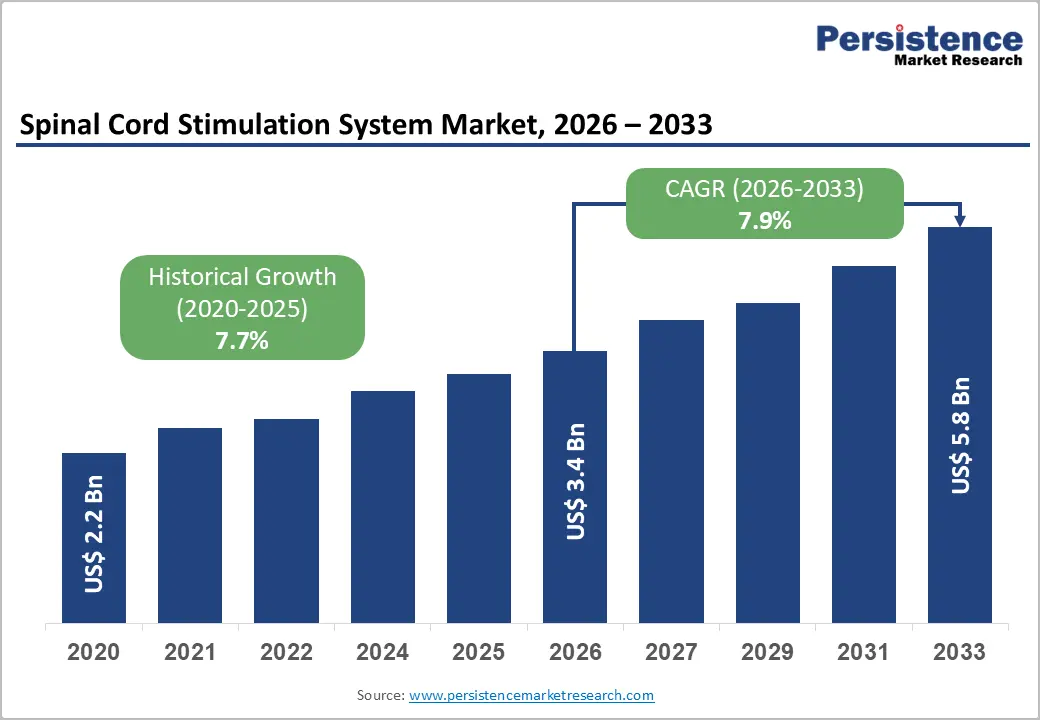
Spinal Cord Stimulation System Market
BRENFORD, LONDON, UNITED KINGDOM, May 20, 2026 /EINPresswire.com/ -- The global Spinal Cord Stimulation System Market is gaining strong momentum as healthcare providers increasingly adopt neuromodulation therapies for chronic pain management. Spinal cord stimulation systems are implantable devices designed to deliver controlled electrical impulses to the spinal cord, helping reduce pain signals before they reach the brain. The market is likely to be valued at US$3.4 billion in 2026 and is expected to reach US$5.8 billion by 2033, growing at a CAGR of 7.9% during the forecast period from 2026 to 2033. Growth is supported by rising cases of chronic back pain, failed back surgery syndrome, neuropathic pain, and demand for non-opioid pain treatment options.
Market statistics indicate steady adoption across hospitals, ambulatory surgical centers, and specialty pain clinics. Rechargeable and non-rechargeable spinal cord stimulation devices are both witnessing demand, while advanced systems with improved programming, longer battery life, and patient-friendly controls are strengthening clinical acceptance. The leading segment is expected to be implantable pulse generator-based systems due to their central role in therapy delivery.
Want Market Insights? Get Your Free Report Sample : https://www.persistencemarketresearch.com/samples/14197
Key Highlights from the Report
➤ The global Spinal Cord Stimulation System Market is likely to be valued at US$3.4 billion in 2026 and reach US$5.8 billion by 2033, growing at a 7.9% CAGR.
➤ Hospitals and specialty pain centers are expected to remain key end users due to higher procedural volumes.
➤ North America leads the market owing to strong clinical adoption, advanced treatment access, and reimbursement support.
➤ Future growth will be shaped by rechargeable systems, personalized stimulation programming, and expanding access in emerging healthcare markets.
Market Segmentation
The Spinal Cord Stimulation System Market can be segmented by product type into rechargeable systems, non-rechargeable systems, implantable pulse generators, leads, and accessories. Rechargeable systems are gaining preference among patients requiring long-term therapy, as they offer extended device life and reduce replacement procedures. Non-rechargeable systems continue to serve patients seeking simpler device management. Implantable pulse generators remain a core product category because they control stimulation delivery and therapy customization.
By end user, the market includes hospitals, ambulatory surgical centers, specialty clinics, and pain management centers. Hospitals hold a strong position due to access to trained specialists, advanced surgical infrastructure, and post-implant monitoring facilities. Specialty pain clinics are also expanding their role as patients increasingly seek focused treatment for chronic neuropathic and back pain conditions. Ambulatory surgical centers are gaining attention as minimally invasive procedures become more efficient and cost-conscious healthcare systems encourage outpatient care models.
Customize This Report for Your Exact Requirements : https://www.persistencemarketresearch.com/request-customization/14197
Regional Insights
North America is expected to remain the leading region in the Spinal Cord Stimulation System Market. The region benefits from high awareness of neuromodulation therapies, strong availability of pain management specialists, and wider adoption of advanced implantable medical devices. Increasing preference for non-opioid chronic pain treatment further supports demand across the U.S. and Canada.
Asia Pacific is likely to show promising growth as healthcare infrastructure improves and access to advanced pain therapies expands. Rising patient awareness, increasing medical tourism, and growing investment in specialty care facilities are supporting regional adoption. Europe also remains an important market, driven by established healthcare systems, aging populations, and growing acceptance of minimally invasive pain management solutions.
Market Drivers
The primary driver of the Spinal Cord Stimulation System Market is the rising burden of chronic pain disorders. Patients with persistent back pain, nerve pain, and failed back surgery syndrome often require long-term treatment solutions beyond conventional medication. Spinal cord stimulation offers an important therapeutic option by targeting pain signals directly through electrical stimulation. This makes it especially relevant as healthcare providers look for alternatives to prolonged opioid use and repeated surgical intervention.
Another major driver is continuous technological advancement in neuromodulation devices. Modern spinal cord stimulation systems are becoming smaller, more durable, and easier to program. Improved battery performance, rechargeable options, and patient-controlled settings are enhancing treatment convenience. These innovations are encouraging physicians to recommend spinal cord stimulation earlier in the pain management pathway, especially for patients who do not respond well to conservative therapies.
Unlock Complete Insights – Buy the Full Report : https://www.persistencemarketresearch.com/checkout/14197
Market Restraints
Despite strong growth potential, high treatment cost remains a key restraint for the Spinal Cord Stimulation System Market. Implantable systems require device costs, surgical implantation, follow-up visits, and programming support, which can limit access in cost-sensitive markets. Reimbursement differences across countries may also affect adoption, especially where advanced pain management procedures are not fully covered.
Another challenge is the need for skilled professionals and careful patient selection. Spinal cord stimulation is not suitable for every chronic pain patient, and outcomes depend on accurate diagnosis, trial stimulation success, and proper device placement. Possible complications such as lead migration, infection, or device discomfort may also influence patient confidence. These factors make clinical expertise and long-term monitoring essential for market expansion.
Market Opportunities
The market offers strong opportunities in emerging economies where access to advanced pain management is improving. As hospitals invest in neuromodulation technologies and patients become more aware of minimally invasive treatment options, demand for spinal cord stimulation systems is expected to rise. Training programs for physicians and improved reimbursement frameworks can further support adoption in these regions.
Future opportunities also exist in personalized stimulation therapy. Companies are focusing on systems that allow more precise programming, better patient comfort, and improved therapy response. Integration of digital health tools, remote monitoring, and smarter device controls may strengthen patient engagement. As chronic pain management becomes more patient-centered, spinal cord stimulation systems are expected to play a larger role in long-term care.
Company Insights
Key players operating in the Spinal Cord Stimulation System Market include Medtronic plc, Abbott Laboratories, Boston Scientific Corporation, Nevro Corp., Saluda Medical, Nalu Medical, Biotronik, Synapse Biomedical, Stimwave Technologies, and Integer Holdings Corporation.
Explore the Latest Trending Research Reports:
Osteoporosis Drugs Market
Antibacterial Drugs Market
Persistence Market Research
Persistence Market Research Pvt Ltd
+1 646-878-6329
email us here
Visit us on social media:
LinkedIn
Instagram
Facebook
YouTube
X
Legal Disclaimer:
EIN Presswire provides this news content "as is" without warranty of any kind. We do not accept any responsibility or liability for the accuracy, content, images, videos, licenses, completeness, legality, or reliability of the information contained in this article. If you have any complaints or copyright issues related to this article, kindly contact the author above.
